What information is needed to design an equipment pad?
An equipment pad requires more than the machine footprint. The designer may need operating weight, centre of gravity, dynamic forces, vibration, anchor loads, maintenance clearances, fluid containment, service penetrations, temperature, and installation method. Exterior units also face wind, frost, snow, and drainage. Supplier drawings should be current and coordinated with structural and civil information. If dimensions or bolt patterns are taken from an old submittal, the delivered equipment may not fit. If dynamic loads are ignored, vibration can affect the machine, nearby slab, or building. The concrete contractor builds the approved design, including thickness, reinforcement, isolation, anchors, grout space, and finish. Survey control and a rigid template keep critical locations stable during placement. Owners should name who is responsible for final equipment data and design approval. Accurate inputs prevent a seemingly simple pad from becoming a costly field modification during installation.
How are anchor bolts and embedded items kept accurate?
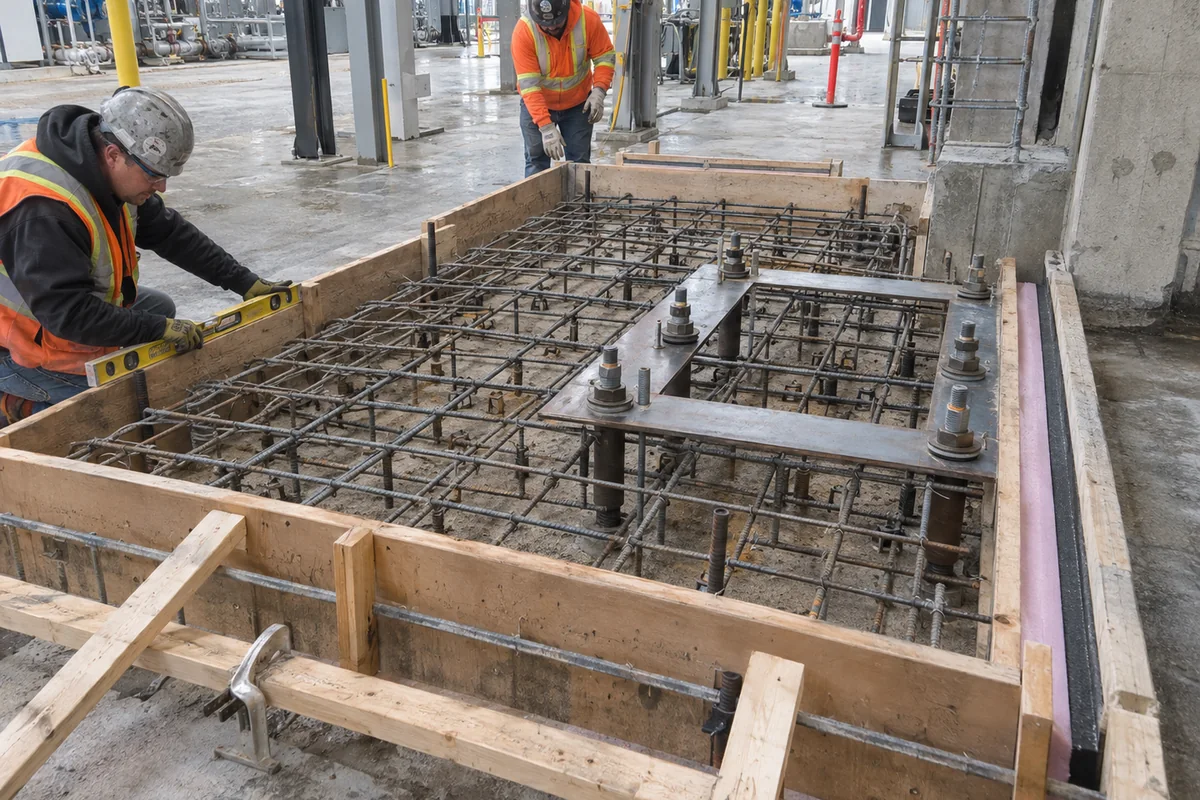
Anchor bolts, sleeves, conduits, plates, and embeds must remain at the correct plan location, spacing, elevation, projection, and orientation while wet concrete is placed and vibrated. A robust template tied to stable control is more reliable than measuring each bolt from a moving form edge. The layout should be checked against the equipment drawing, not only the structural plan, and conflicts should be resolved before the pour. Congested reinforcement may require a planned placing and vibration approach so concrete surrounds each item without voids. If bolts move, bending or enlarging holes in the field may violate the equipment or structural requirements. After placement, the template remains protected and locations are verified before installation. Professional layout, bracing, and inspection are inexpensive compared with replacing a pad or delaying a crane and commissioning crew. Precision is part of the concrete scope whenever equipment depends on fixed anchors.
Why are vibration and isolation important for machinery foundations?
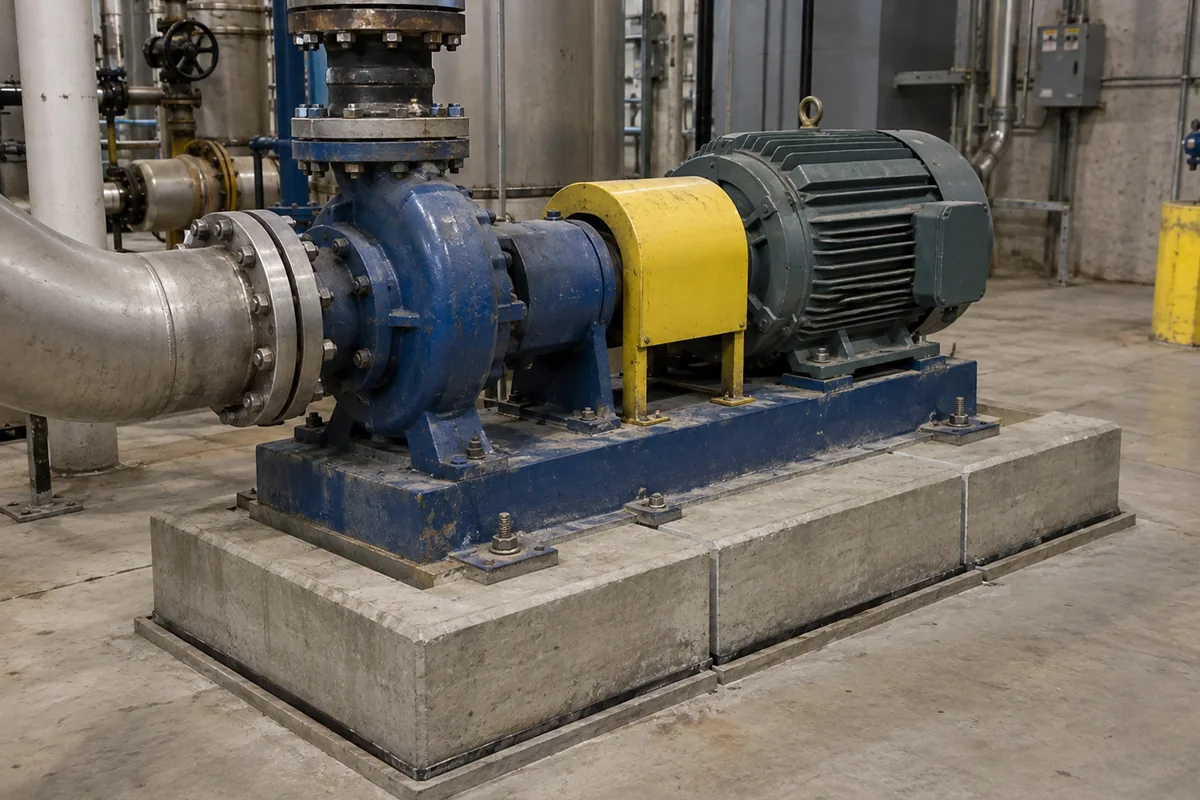
Rotating, reciprocating, or impact equipment can produce forces that ordinary static loading does not capture. A machinery foundation may need sufficient mass and stiffness, special reinforcement, inertia blocks, isolation joints, pads, or vibration-control components. Connecting it rigidly to a thin surrounding floor can transmit vibration, cause cracking, or affect sensitive processes. The equipment manufacturer and structural or vibration specialist should define the requirements. Construction must preserve isolation gaps, anchor details, grout zones, and level surfaces. Debris bridging an isolation joint can defeat its purpose. Delaying a vibration concern until startup may lead to repeated alignment problems, noise, bearing wear, or concrete damage. Concrete placement quality, consolidation, curing, and dimensional accuracy all influence the final installation. A coordinated design protects the machine and surrounding facility instead of expecting a generic slab to absorb unknown dynamic forces.
How do services, containment, and drainage affect a pad?
Equipment often connects to power, fuel, water, drains, controls, or process piping. Sleeves and conduits must emerge in usable locations without weakening anchors or reinforcement. Tanks, chemicals, oils, and washdown may require curbs, sumps, coatings, or secondary containment designed for the stored material. Exterior pads need positive drainage that does not direct water into equipment or create ice at service access. If these systems are coordinated after concrete, field drilling and surface channels can compromise protection and create trip hazards. The project team should overlay equipment, structural, mechanical, electrical, and civil drawings before forming. The concrete finish should also suit grouting, coating, cleaning, and traction. Professional coordination ensures the pad is not merely level concrete but a functional base integrated with all services and environmental controls.
When can equipment be installed on new concrete?
Equipment can be installed only when the concrete has reached the strength or age required by the design, supplier, anchoring system, and lifting plan. Surface hardness does not prove full strength. Heavy crane outriggers, point loads, torque on anchors, vibration, or non-shrink grout may require specific milestones. Field-cured or laboratory test results can support release when the project specification provides for them. Installing too early can crack the pad, damage edges, loosen anchors, or reduce bond. The sequence should include curing, form removal, survey, surface preparation, strength confirmation, equipment setting, levelling, grouting, and commissioning. Temperature affects strength development, so a calendar assumption can be unreliable in cold conditions. The contractor and project manager should record who authorizes loading. A defined release plan protects the finished pad and avoids pressure to accept machinery simply because the delivery truck has arrived.
Discuss your project
Share the location, scope, timing, and any site conditions that may affect the work.